live by your convictions

Margaret Thatcher 13 October 1925 – 8 April 2013

Margaret Thatcher
13 October 1925 – 8 April 2013

The former UK Prime Minister, Margaret Thatcher, died last week. She was the only woman to have held that prestigious and powerful position in the UK, and she earned the title, “Iron Lady” because of her strong leadership style.

The life summaries and tributes to her make it clear that she was not a “Mr. Nice Guy” kind of leader, instead she often alienated people into “love her or hate her” opposing factions. No matter what opinion I may have on Mrs. Thatcher’s political career, I can learn leadership lessons from her life.

In some of my early leadership experiences, I was very self-conscious, with a profound desire for people to like me and to agree with my decisions. I believed passionately in our vision and mission and wanted others to enthusiastically join with me to achieve our goals. I often took criticism very personally, and I felt that rejection was against me and my character, instead of against the idea or process. Mrs. Thatcher clearly understood that does not work for leaders: 

“If you just set out to be liked,
you would be prepared to compromise
on anything at any time
and you would achieve nothing.”

I have learned – the hard way – that I will never please everyone with my decisions or plans. People are very different in their preferences and perspectives, and often have completely opposite, conflicting ideas about how to move a project forward.I need to listen carefully to the differing opinions and weigh out their value, but then I must make the decision I believe in. My leadership goal cannot be to please people, but rather to lead by convictions.

“I am not a consensus politician.
I’m a conviction politician.”

Margaret Thatcher

At the end of the day, I may only be able to say that given the knowledge, experience, and guidance that I had at the time, I made the best decision I could. No matter the outcome of the decision, when I am swayed to do something I do not truly believe is right, I am often haunted by regret. Whenever I choose to lead by conviction, I have peace in the end.

Do you struggle with wanting to please others? What helps you live by conviction?

_____________

A few other places to read about Margaret Thatcher…

http://www.margaretthatcher.org/essential/biography.asp
http://www.bbc.co.uk/history/people/margaret_thatcher
http://www.leadershipnow.com/leadingblog/2013/04/former_british_prime_minister.html 

Isolated Leadership: Dangers and Solutions

To my Maturitas Cafe readers… I couldn’t pass up the opportunity to share this post with you. It combines two of my all-time favorites – Henry Cloud and Dan Rockwell – experts and amazing encouragers in the areas of life and leadership. If you don’t already, you will want to check out Dan’s blog, “Leadership Freak” and follow him on Twitter. Leave a comment on his blog today for the great package offer!
You will also want to listen in on Henry’s free live call today (details in the post) or read some of his great books. I have reviewed some of them (Integrity and Necessary Endings) already in my posts. These guys are the real deal!
What can you do to prevent isolated leadership in your life?

Dan Rockwell's avatarLeadership Freak

Dr Cloud on failing
Isolated leaders inevitably run down, grow ineffective, and become irrelevant. Closed systems die slow deaths.

Don’t wait for the energy fairy. She ain’t coming.

What happens when you place a frog in water that’s slowly being heated? They don’t jump out, they die.

The increasing heat of leadership subtly cooks isolated leaders.

Isolation feels safe but it kills.

You’re isolated and running down if you feel:

  1. Disconnected.
  2. Distrustful.
  3. Unsupported.
  4. Misunderstood.
  5. Constantly guarded.

Warning: Leaders frequently lean toward isolation.

In his new book, “Boundaries for Leaders,” Dr. Henry Cloud says:

“Set boundaries on your tendency to be a ‘closed system,’ and open yourself to outside inputs that bring you energy and guidance.”

Solitude isn’t a leadership strategy.

Open yourself to influence, input, and support from outside your organization. Closed systems inevitably die. Dr. Cloud says the benefits of outside input includes:

  1. Insight into new models of leading.

View original post 130 more words

chocolate, character and community

I love chocolate. Chocolate cake, chocolate cookies, chocolate pie, chocolate brownies, chocolate candy (especially with nuts). I can easily pass on most sweets… but not chocolate. Over the years, my tastes have drawn me to dark chocolate. That is now my unquestionable favorite.

yum webWhen I was recently in Birmingham in the UK, we had the opportunity to tour the Cadbury factory. What a treat! I have always enjoyed learning about how things are made, but chocolate… the best of all worlds! It was a chilly day for walking around… but so worth it! Our first stop included a sample of warm, melted chocolate over our choice of toppings. It was amazingly delicious – as you can tell!

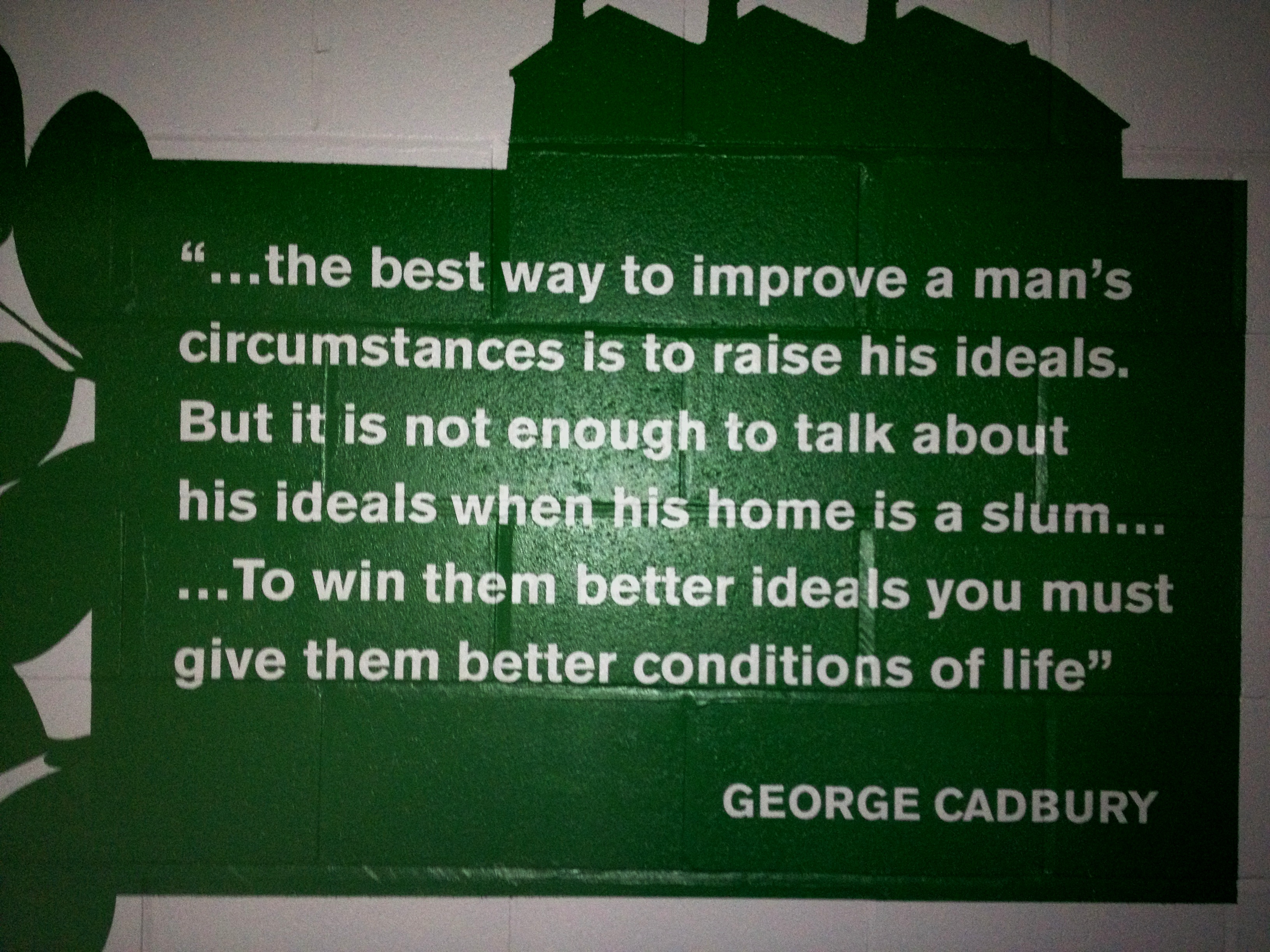
better conditions webWe then moved on to displays that demonstrated a bit of the history and processes. A friend had encouraged us to look for the Human Resource connections in the company foundations, and we were not disappointed. George and Richard Cadbury were men of great character. They obviously cared for people as well as profit… and did not sacrifice quality or integrity to accomplish both goals. There were numerous testimonies and historical evidences of the Cadbury’s commitment to their employees and their families. The Cadbury brothers provided out-of-the-norm housing and education opportunities, dental and medical care, recreation and vacation possibilities for their workers. I have often sensed the tension between people and production, but these men have proven that both can flourish together.

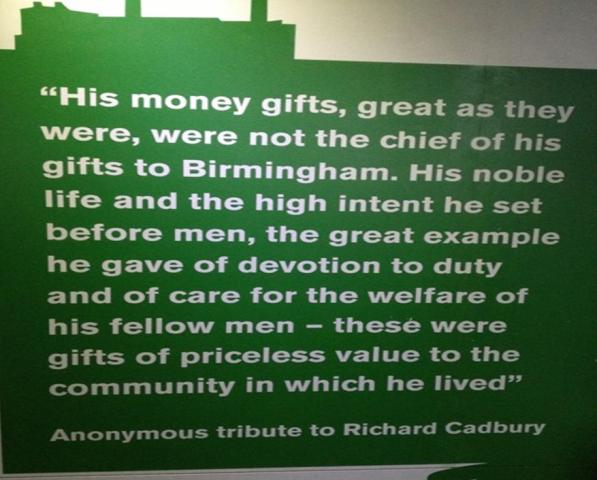
greatest gift horizontal webGeorge and Richard took care of their people by providing community. In 1879, the Cadburys expanded their facilities… and their contributions to Birmingham. The factory, called Bournville, was known as a “factory in a garden” because of the stream, green areas, and gardens all throughout. It is still a very attractive place today. The brothers built homes, schools, hospitals, reading rooms, and gardens for what became known as Bournville village. George and Richard understood that as they invested in individuals, they ensured a society change ROI also. Their example was inspiring to me as I dream about the positive impact that my actions can have in a scope much larger than my own life.

I’ve included a few references below if you’d like to read more about the Cadbury legacy. I suggest that you accompany your study with a Cadbury Milk bar or a Cadbury Egg – for maximum educational benefit!

IMGP0120

Have you experienced leaders who are able to combine care for their people and profit/success?

__________

http://www.spartacus.schoolnet.co.uk/REcadbury.htm
http://www.cadbury.com.au/about-cadbury/the-story-of-cadbury.aspx
http://candyhalloffame.org/CHoF/inductees/2005/richard-george-cadbury.shtml

how to know yourself better

reflection morguefile webDo you like homework? Neither do I… usually.

However, this fall I had to do a homework assignment for our Global Leadership MA class that I want to recommend to you. It was, by far, the most encouraging homework assignment I have ever done. The exercise is called “Your Reflected Best Self” (RBS), and it is fully described in the Harvard Business Review article, “How to Play to Your Strengths” from January 2005.

The exercise is not designed to build your ego, although it might do that. A while back I wrote about how we often receive six comments of negative feedback to one positive. The RBS is a systematic tool that balances out that ratio by discovering or confirming strengths and potential. With some analysis and application (done best with the help of a coach), you can use the information gained to develop a plan to maximize your talents at work and in other areas of life.

It works like this:

Step 1: identify a variety of people to give you feedback

Chose 10 to 20 people – family, past and present co-workers and bosses, friends, etc. Send them an email like this…

Dear XXXX,

As part of my personal development program, I am constructing a profile of the ways that I add value and contribute. I am contacting twenty people who know me well from a variety of relationships: family, friends, co-workers. I am requesting that each person provide me with three stories of when I was at my best and my strengths were meaningful to them in some way. I would like to invite you to help me with this exercise.

I appreciate you taking time to do this for me. Please provide specific examples so I can understand the situation and the characteristics you are describing. One short paragraph will be fine.

1. One of the ways that you add value and contribution is: _______

For example….

2. Another way that you add value and contribution is: _______

For example…

3. One last way that you add value and contribution is: _______

For example…..

Please email your responses to me by XXXXX.

Thanks so much for your help!

Step 2: observe patterns from the responses received

Enjoy reading the email responses! A good way to see the common themes is to create a chart. It might look something like this…

Common Theme

Examples Given

Possible Interpretation

Ethics 1. I stood up to a peer who was crossing the line of ethical behavior. 

2.

I am not afraid to choose right over wrong.
Team Builder 1. I coached our softball team. 

2. I created a work group for a big project. 

3.

I thrive working with others.

Step 3: write a personal profile and compare it with your day-to-day life

After you summarize the feedback, you will know yourself better and the tasks, atmosphere, and relationships that energize you and facilitate your strengths. You can then evaluate where and how often you get to use your talents. Those are likely the times, projects, and situations where you are most encouraged and most productive. If you are not using your best self very often, you can understand why you feel tired and discouraged.

Step 4: redesign your job 🙂

It is not always possible to redesign your whole job, but sometimes there is freedom to make a few key adjustments. We can also make changes at home to allow more time for the people and the tasks that bring out the best in us. This is when coaching is helpful – to think through where to make the changes… and help us actually follow through.

I learned a lot about myself by doing this exercise; I hope you will too. If you decide to try it, please let me know what you find out about your Best Reflected Self!

what women add to a team

Business TeamDo you remember that awkward elementary school experience – two scrawny kids choosing the players for their team? There was always a tension between picking a friend because you liked them and picking a “star” because you wanted to win.

Whether it was a debate team or a football team, you needed a variety of players to cover offense and defense. Your choices didn’t always work out as planned. The thick glasses didn’t always guarantee intelligence any more than extra height ensured skill under the basket, but certain general characteristics proved to increase your chances for victory.

I firmly believe that men and women live and work best together in partnership, and I have experienced many times that the best teams are often diverse, not only in gender, but also in age, personality, strengths, and cultural background.

Earlier, I wrote about some of the challenges facing diversity, specifically gender diversity on leadership teams. I mentioned that more information can often facilitate positive change. Here are some ways that women’s participation makes teams healthier and stronger. I have also listed some articles below that support these three points. 

Men and women are like two feet—
they need each other to get ahead.
Helen E. Fisher

Women add integrity.

In my experience, the women on my teams consistently committed to maintaining a high standard of fiscal, legal, and labor integrity. When women participated on the teams, we implemented accountability systems, complied with necessary policies and laws, and quickly investigated decisions that appeared questionable. Financial partners, funding, and the organizational reputation for integrity increased as a result. When women participate on a team, there is great potential to build a strong ethical, moral, and integral foundation. 

Women strengthen collaboration.

On mixed teams, the team members rarely worked alone in siloed responsibilities. Instead, the women facilitated true teamwork by ensuring regular communication and interaction, systematic sharing of ideas, and fostering a healthy feedback culture. They promoted honest personal and productivity evaluations. The women were approachable, quick to ask clarifying questions, reciprocally helpful, and loyally supportive of team decisions. Mixed gender teams often led to better ideas, better decisions, and greater productivity and growth.

Women foster personal development.

The women I worked with prioritized personal and team development, often establishing strong mentoring relationships and coaching. They actively demonstrated concern for team member’s growth and well-being. The women readily participated in 360 evaluations, team building activities, and conflict resolution. They were good listeners, discerning, and keenly aware when alignment was missing. They were often very successful at recruiting, training and empowering their future replacements. Women leaders contribute to the effectiveness of a team’s leadership pipeline. 

I believe that great leadership ultimately depends on character, and that calling, competency and chemistry are also important for successful teamwork. Diverse teams do not ensure automatic success, but in our complex and constantly changing society, I am certain that they are one of our wisest recruiting strategies.

How have you seen women add to your teams?

McKinsey & Company. (2008). Female leadership, a competitive edge for the future. Paris, France.
Zenger, Jack and Folkman, Joseph. “Are women better leaders than men?” blogs.HBR.org. March 15 2012. Web. Jan. 26 2013.

why is diversity so hard?

studying togetherWhy is it so hard?

I often asked this question regarding my children when they couldn’t seem to get along. I have asked it about financial integrity, about exercise discipline, and about conflict resolution. These good goals seem to immediately attract excuses, emotional responses, and resistance as soon as we mention them.

Today, however, I ask it about men and women working together with mutual respect, equal opportunity, and sincere appreciation of the varied passions and strengths that both bring to the table.

Why is diversity so hard?

Why haven’t we been able to eliminate the disrespectful jokes and comments? Why don’t we apply the abundant literature that states how important it is to have gender diversity on teams and in leadership in order to increase the health and productivity of our organizations? Why do we continue to make excuses for antiquated policies and “old school” leaders that we know need to change? Why aren’t we willing to have honest and open discussions about moving beyond stereotypical criticisms and moving toward understanding, equity, flexibility, and progress?

I have actually been blessed to work in many situations and on many teams where men and women contributed and collaborated well together as unique individuals, valuing and appreciating variety in gender – as well as culture, age, experience, and expertise. Sadly, I have also worked in settings where people chose sides in constant battles for respect and opportunity.

I don’t believe there is any legitimate reason for such disparity and division between men and women. My faith tells me the root cause is our selfish sin…. thinking more highly of ourselves than we think of others, which leads to lack of respect, competition, insecurity and defensiveness. Maybe that is why this struggle is so entrenched and why it is so hard to defeat.

Although I get weary of the conflicts and I don’t have answers to all the questions, I think this challenge is worth fighting for – just like sibling love, balanced budgets, a strong body, and healthy relationships. Excuses, emotions, and resistance yield to information, open communication, and accountability for positive change. Offenses can transform into advocacy. I’d like to see grand-scale improvement, but many days I accept being content with small steps of progress. I start with changes in my life, and then I move to being an example for others. Maybe it will always be hard… but it can get better.

One day our descendants will think
it incredible that we paid so much attention to things
like the amount of melanin in our skin
or the shape of our eyes or our gender
instead of the unique identities of each of us
as complex human beings.
-Franklin Thomas

What do you do with hard situations? How do you bring about change?

maturitas cafe – best of 2012

I would love to enjoy a steaming cup of black coffee with you at a comfy, warm cafe. We could talk about so many things – work, family, teams, marriage, life! We might laugh or cry or philosophize, and share advice or struggles or funny stories. We might disagree about a topic or empathize completely. No matter what, I know we would end our visit grateful for the time together.

Until we have that opportunity, I am grateful for the chance to connect this way. THANK YOU for reading and leaving your “likes” and your comments. You have challenged me and encouraged me this year. You have led me to new blogs, new ideas, new friends. I appreciate you very much and look forward to learning more together in 2013!

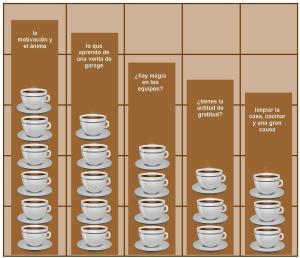
In case you are new to this blog or might have missed a post, here are some of the top (most read) posts of 2012. Feel free to look around at the archives too. Remember every post is available in English and Spanish…

eng top 5top five English posts:

today’s modern woman – pick any two

cleaning house, cooking meals and a greater cause

are you dangerous?

communication styles

tips for long lasting friendship and marriage

sp top 5top five Spanish posts:

la motivación y el ánimo

lo que aprendo de una venta de garage 

¿hay mágia en los equipos?

¿tienes la actitud de gratitud?

limpiar la casa, cocinar y una gran causa

You might also enjoy reading a little about me and why I started this blog:

coffee as a way of life      why a blog?

 Thanks for joining this journey! 

Please let me know… what was your favorite post this past year?

leadership is hard

hard leadershipI been discouraged about leadership lately. Every time I think about it; I think of the word – hard. Leadership for me has been hard: hard work, hard on my health and relationships, hard on my emotions.

Leadership is hard when I start…

The inevitable learning curve – so many unknowns, so much new: people, partner inter-relationships, systems, policies, standards, expectations, schedules. Insecurity. Comparison. Uncertainty. So many questions: Can I do this? Will others respect me? Can we accomplish the mission? Where to start? What are the first steps? Where can we find some quick wins?

Leadership is hard in the process…

Constant crisis. Problems. Challenges. Never enough leaders, resources, or funding. Bad attitudes, resistance to change, gossip and back-biting, team conflict, long hours, extra meetings. I struggle with setting boundaries, discerning my – and others’ – responsibility, balancing my heart and my head in decisions.

Leadership is hard when it’s over…

It is hard to watch others take over – with new ideas, other ways of doing things, different values. It is hard to watch prior co-workers struggle with the change, feel less valued in the new systems, lose their positions and their jobs. I have no authority or influence, but I still have concern and care. I observe from a distance – powerless, frustrated, trying to trust and believe the best, knowing I need to move on.

Days like today, I don’t want anything to do with leadership.

… and then I remember… leadership was also hard for the Greatest Leader of all time.

He had difficult, humble beginnings. He didn’t have my confidence issues, but He did have to prioritize His work. He experienced all kinds of conflict in the culture, society, and with His co-laborers. He dealt with others’ immaturity, character issues, and lack of integrity. He got tired; His leadership finally got Him killed. And then He had to leave the job to others who didn’t appear ready. They didn’t continue to do things like He did.

… but that was all part of the plan.

Yes, leadership is hard. The trick is to expect the hard parts, rather than trying to escape what is difficult. The key is to face into the challenges and grow up to handle them. Hard isn’t necessarily bad.

And remember, when we lead, we are in good company.

What do you do when leadership is hard?

blind spots

Traveling down the highway the other day, we saw many people texting or talking on their phone as they drove. Their speed was erratic, and they were constantly swerving from one lane to another. I felt nervous and in danger anywhere close to them, I and encouraged my husband to put some distance between us as quickly as possible.

It came to my mind that this dangerous behavior is very obvious to others, although the texting-driver may mistakenly think they have everything under control. From behind, we watch the unintentional lane changes and make adjustments for their inconsistent speed. When we pass along the right – because they are usually blocking the passing lane – we have never been wrong in our initial hypothesis as to the cause of their erratic driving. They are often so intent on their communication that they do not look up or even notice as we pass by.

Blind Spots  = obvious to everyone except me

I can have blind spots in many areas of my life. I am often so busy with my own tasks and concerns that I am completely unaware of how my attitudes and behavior are affecting others. I hate to think of how often a family member has to move out of my way for their own protection, or how often a co-worker has to make adjustments for my erratic actions.  I don’t want to be a danger to others. 

One tool we use in our organization is the 360° review; a feedback survey process that allows those around me – supervisor/director, co-workers, direct reports – to let me know how I am doing in my leadership. Their confidential responses are correlated with my self-assessment answers, and a trained feedback facilitator communicates the information during a personal appointment. The feedback confirms obvious strength and weakness areas, encourages strengths (those others saw, but I didn’t mention), and warns me about the dreaded blind spots.

The first time I went through a 360° review, it was one of the hardest things I had ever done. I felt clobbered by the negative comments and had a hard time recognizing the positive. I had a great facilitator at the time, and I have since come to greatly appreciate the process. I know that when I invite truthful feedback in my life, I grow in humility and I increase my abilities to work productively and serve others well.

I can hear truth from others in a formal 360° review or simply in vulnerable conversations with friends, family and mentors. It is one of the most important things I can do to ensure that I am a safe person, considerate of others, and aware of my impact… less blind spots! 

Have can you invite someone to give you honest feedback about your blind spots? 

looking in the wrong place

I want to do something worthwhile, valuable, important. I want to leave a legacy. In an earlier post, I wrote about my discouragement and concern that I hadn’t left the culture change legacy that I wanted in the organization. Over time, the organization took on a different look, a different personality, and I felt like a failure…
Where was the legacy?

The other day, I was processing this struggle with my husband. The more we talked, the more I came to realize that I was looking for the legacy in the wrong place. I wanted an environment, procedures, and structures to display our influence after we were gone.

I think now that the organization simply provided the “front” for the work we wanted to do; it would not be my source of legacy. I believe I find my legacy in the people I worked for and worked with, in the changed lives – nurtured, grown, changed, empowered, hope-filled… in the environment we built to work from.

Perhaps the “temporary” place we created was never intended to last forever – maybe we built it as much for us as for others. It served an important purpose for a time. It provided a context for us to work out our calling… while we were there.

I am not really very concerned about turning organizations around. I do want to bring a positive influence, and I do hope to lay a path that makes it easier for others to follow. I think that I am more passionate about turning lives around. And that, thankfully, I did get to do from my leadership position.

Some of those changed lives will lead to generations of change. Many will use their influence to create and multiply environments where others can grow. Their changed lives mean changed families and changed businesses, and contribute to changed cities… and eventually a changed world! I feel more encouraged with my search… maybe my legacy is not so quickly and easily visible, but it is definitely a legacy that was worth the effort.

Where do you want to leave a legacy? Are you looking in the right place?