discomfort with diversity

diverse handsHow great is my committment to diversity? Do I give lip-service to the concept or do I live out my convictions with my attitudes and my actions?

I have been considering these challenging questions a lot in the past weeks, after reading two posts that tied diversity to discomfort. The basic premise explained that diversity will cause discomfort for me.

When I work, worship, or play with people who are different from me, they will present words, ideas and ways of doing things that are different from my personal preferences.

That might be more discussion or less than I like. More noise or less. Different music. Different flavors. Different values. More technology or less. More detail or less. Quiet work space or open collaboration. Different colors. Different styles. More emotion or less. More time together or more time alone. Spend more or spend less.

Because not everyone is like me,
if I am comfortable all the time, then others are not.

I work with diverse teams and with a great variety of people from all over the world. Each of my friends and each member of my family is different. If I truly want to invite, encourage, and empower the unique people around me, I must feel uncomfortable some of the time… and not just tolerate the discomfort, but really embrace it as a means to greater diversity.

  – gender – race – age – nationality – personality – religion – family background –
– economic class – political party – experience level – strengths and weaknesses –

All of these differences can cause discomfort and even conflict… but they are the source of rich diversity at home and at work.

diversity

Photo credit: estherase / Foter / CC BY-NC-SA

Instead of having a goal to make everyone happy; we could each willingly accept unhappiness some of the time, knowing that means someone different feels satisfied.

Rather than seek my own way, I am slowly learning to become more comfortable with my discomfort and celebrate – and even intentionally seek out – diversity that challenges me.

How do you react to situations that make you uncomfortable? What do you do to embrace diversity?

a heart check-up for leaders

You can’t lead if no one follows.

On the other hand, a lot of people don’t think they are leaders because they don’t have a business title or position, but others are watching them and following their example all the time. We can all learn to lead better.

I had the privilege last week of attending the Willow Creek Global Leadership Summit. Bill Hybels, the founder of the Summit, spoke first. He shared three hard-fought leadership lessons from his experience. This is my adaptation of his first point:

stethoscopeTAKE CARE OF THE HEART

“Oftentimes, leaders with the highest level of vision and passion have the lowest awareness of the spirit of their team.” ~ Bill Hybels

Leaders can get so fired up about their vision and strategies that followers begin to pay the price. The leader starts to view everyone else as caring less about the goals than they do. The leader then determines that if the followers don’t care about the vision, then the leader doesn’t have to worry about the followers’ heart… and those followers become expendable.

This attitude may not get expressed out loud, but everyone can feel it.

Some ways to protect against this error and truly care for your people:

  • Do an objective/outside evaluation. Bring in a professional team, get a coach, ask a friend. Find out what your followers are thinking and feeling. Have someone else give you honest feedback about how you are treating your team (or students, or children…) with your attitudes and actions.
  • Make sure the leader and team “own” the desired culture. If the leader does not lead by example, others will get frustrated with the hypocrisy and not embrace or apply the culture either.
  • Get serious about training the leaders who manage other people. Some people simply should not lead. If others are continually getting hurt, discouraged, held back, or frustrated by a leader – do something about it! Hybels said, “People join organizations, but leave managers.”
  • Increase the level of candor in evaluations/reviews. An easy format to use is the Start, Stop, Continue categories… and be specific! People (including children!) want desperately to know, “How am I doing?” They can’t get better or grow in areas, if they don’t know what it is that they need to improve.

The kindest form of feedback is the truth. 

  • Practice a ruthless commitment to conflict resolution. View conflicts not as burdens, but rather as opportunities to strengthen the relationship. (more on this area in a coming post!)

WOW! I have plenty to work on here… and that was just his first point! I’ll write about more of the sessions in upcoming posts.

Is there anything you would add to this list? How do you care about the heart and spirit of the people who follow you?

eradicating emotional abuse

bored
He arrived a half hour late and offered no apology for the rudeness. He sat back from the table, alternately leaning back in the chair with his arms reaching behind his head or rubbing his eyes with his hands. His eyes wandered, expressing boredom and disinterest in the conversation. He said nothing during the whole meeting.

He was not there as an observer. He was there to discuss a partnership, a potential working agreement with the other attendees. His supervisor was also in the room.

No one confronted him. No one asked if he had a problem or if there was some reason he was not participating or if the meeting should be re-scheduled. The meeting continued with tension in the room and without resolution.

The others left with a sense of frustration, time wasted, questions unanswered… and just a hint, down deep, of self-doubt… wondering if somehow they were the cause of that strange behavior, or if somehow they had done something wrong, or if the other was normal behavior and they were the strange ones to expect something different…

From the outside, from a position of healthy relationships, I wanted to scream for them… THAT IS NOT NORMAL BEHAVIOR! In emotionally healthy work environments, people do not act that way at meetings! And if they did, someone would say something to them… quickly!

That was clearly passive aggressive behavior designed to intimidate, discourage, and display lack of respect and value for the others attending the meeting. It was immature, inappropriate and rude behavior.

Sadly, in an isolated setting, without healthy examples around, it is easy to lose perspective and not recognize the harmful behavior. Or when someone has been through too many situations where they are not respected or valued or validated, a person can begin to perceive the negative behaviors as normal. Psychologists sometimes identify this as learned helplessness, and it is common in physical abusive situations also. Others react with anger in return.

How can we teach the ones we care about to recognize emotional abuse when they experience it? How can we help them respond with confidence and control, without allowing the passive aggressive offender to affect their minds or the meeting?

Have you faced situations like this? What would you suggest?

Catching Fire leadership

Catching FireLast night I went to see the premiere of “Catching Fire” in the IMAX theater with my niece and other family members. She was very excited. I had not read the books, and I’m not a big movie fan, but I was there to enjoy the experience with her and make a special memory! Popcorn and candy are always fun!

I admit that I liked the movie more than I expected. I thought it was better than the first film “The Hunger Games”: on-the-edge-of-your-seat action, intertwined relationships, and a battle for the underdog. Except for the futuristic, sci-fi elements (not my favorite film genre), the story grabbed my attention, and I forgot everything about real life for the entire 2 1/2 hours.

This morning when I woke up and my mind went back to my MA courses, I started thinking about some fun connections between the movie and the leadership themes I have been studying. Here are a few of them…

The main protagonist characters, Katniss and Peeta, demonstrate leadership character with courage, sacrifice, loyalty, love and care for others, and convictions that can not be bought or beaten out by corrupt powers. They win the sympathy of many with their integrity, perseverance, and compassion, and become attractive role models for the youth.

The heroes have a compelling vision – They symbolize hope for the future and the belief for many that together they can improve life for themselves and for those who come after them. Katniss and Peeta plan some tactical steps for survival and also prepare for unknown and unexpected circumstances and challenges.

Katniss and Peeta work with an amazing team – Coaches and mentors help with marketing, strategy, spokesperson roles and survival training, providing experience, knowledge, and resources. They know they could never survive the competition without the help of others.

Partners and Alliances are a key part of the survival plan – These partnerships require trust, respect, watching each other’s back, working together, each offering their unique expertise and help from their strength areas. The intense focus on an external enemy allows them to accept and appreciate others who are very different.

These are just some ideas that I thought of quickly as I enjoyed remembering the movie. I’m sure there are many more. If you’ve seen the movie or read the book, what principles do you see?

And… if you are struggling with a type of “The Capital” in your own life or at work, may the odds be ever in your favor! 🙂 The application of some of these leadership principles might help!

facilitating change

IMGP0641 webChange: heart attitudes, training styles, organizational culture… and the world!

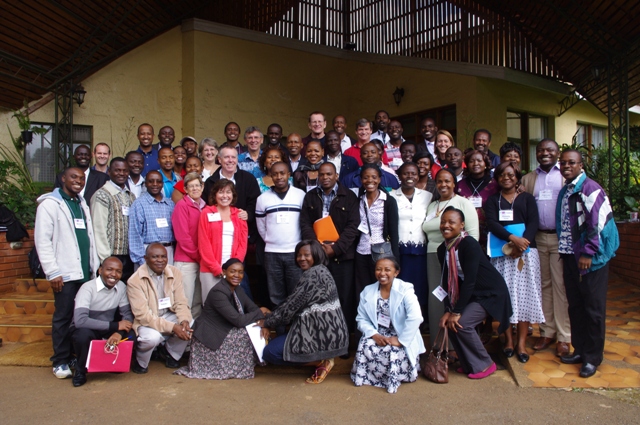
I just returned from a week in Kenya where I greatly enjoyed a transformational time with 50 of our African staff – to help them learn new training paradigms and materials to use with their new staff. Men and women, grandparents and young singles, they came from all over the continent: Ghana, Swaziland, Ethiopia, Niger, Zambia, Uganda, Zimbabwe, Cameroon, and more… They spoke English and French, in addition to many national ethnic tongues. They had up to 20 years of training experience or none. They work with students, business professionals, families, athletes and rural communities.

How to help such a diverse group desire, understand and prepare for change? Change is hard. Change is powerful.

We began with vision. Vision for them. Vision for their work. Vision for the organization. Vision for the world. We talked about the value, privilege and responsibility we experience when we invest in others’ lives.

They studied the character of those who are willing to change – humble, teachable, life-long learners, innovators, team players – and evaluated their own…

Our Design Team demonstrated the power of teamwork, adult learning, creative teaching methods, coaching processes and coaching groups, shared leadership, freedom to fail, and growth in community.

We also discussed the challenges and the barriers to change – their own personal internal struggles and the organizational struggles: traditions, aligning others, resources.

We modeled, and then they practiced with new tools… teaching new lessons, coaching each other, leading interactive groups, giving and receiving feedback.

Everyone ate well and slept little; we drank lots of tea; we shared life stories and prayed for each other. We became friends.

Together they decided on action points and next steps.

Our staff have a long road ahead of them. Change does not happen overnight. It does not happen easily. They will face opposition, and they will get tired and frustrated and discouraged in the process.

But I have hope for them. They are deeply committed to their people and their purpose. They serve a great God. They will help each other in a learning community. Change is healthy and necessary for the future.

I feel honored to have been part of the time. I look forward to what will happen in the future.

How do you respond to change? How do you help your people prepare for change?

questions for a destination

Roundabout SignageHave you ever had a conversation with someone that went around and around in circles and ended without any resolution, next steps, or action plan? That might be OK for some informal or ideological discussions, but a coaching relationship helps the client make progress towards a goal.

An effective coaching process begins with the client (or spouse/child/co-worker/friend) choosing a personal or professional goal, and then discussing options and barriers with the help of open and probing questions from the coach. Once the client chooses their best option, it is time to move the conversation towards action steps.

I recently learned three types of questions that the coach can ask to help the client move forward: Direct, Revealing, and Ownership.

DIRECT Questions:

Good direct questions focus and challenge, but do not threaten or judge. They are neutral and inquire without using guilt. They avoid the word “why”. They ask for action or decision and point toward a positive outcome.

“What will you do?” “Do you want to focus on XXX or on XXXX?”
“What investigation have you done?”
“What might you need to do to ensure a good decision?”

REVEALING Questions:

Revealing questions help people “get out of the box” when they feel stuck and unable to move forward. They help the client discover the limitations (physical limitations, finances, fear, priorities, lack of information, etc) they view as unchangeable obstacles and look for creative alternatives.

“What if you thought outside of the normal structure?”
“Who else could help you?” “What could you do differently to free up new resources?” “What if you had four extra hours in your day?”
“If that difficult person wasn’t there, what would you do?

Another option is to help them imagine a new situation without the barrier… “What if you had all the time you needed, what would you do?” “If you couldn’t fail, what would you try?” “How would your perfect job look?”

OWNERSHIP Questions:

Ownership questions help people avoid blaming others and take responsibility for the action. They help take away justification, excuses, and passivity, and instead lead to growth opportunities.

“What might you have done that contributed to the conflict?”
“How can you make things better?” “What might you do differently?”
“Which step do you want to take?” “How do you want to do that?”

A last helpful tip or two… When your client talks about action steps, help them be as specific as possible and include timelines.

Usually, in a coaching situation, the coach is simply helping the client recall or use their own existing information and knowledge. If, as the coach, you feel the situation requires your input, ask permission before you speak!

“Can I challenge you on that?”
“Would you be open to hearing a different perspective?”

These questions can help us get out off of the roundabout and on to our destination!

Which of these questions might be most helpful to you?

______

Many of these questions and more can be found in Leadership Coaching by Tony Stoltzfus. I highly recommend the book!

do nice girls finish last?

Lean InI am making my way through Sheryl Sandberg’s book, Lean In, and chapter three made me stop and think a bit. The chapter is called “Success and Likeability”, and Sandberg starts out with a Harvard Business School case study based on the experience of an entrepreneur named Heidi Roizen. Sandberg writes:

The case described how Roizen became a successful venture capitalist by using her “outgoing personality… and vast personal and professional network [that] included many of the most powerful business leaders in the technology sector”. [The professors] assigned half of the students to read Heidi’s story and gave the other half the same story with just one difference – they changed the name “Heidi” to “Howard”.

[The Professors] then polled the students about their impressions of Heidi or Howard. The students rated Heidi and Howard as equally competent… their accomplishments were completely identical. Yet while students respected both Heidi and Howard, Howard came across as a more appealing colleague. Heidi, on the other hand, was seen as selfish and not “the type of person you would want to hire or work for.” The same data with a single difference – gender – created vastly different impressions.¹ (emphasis mine)

Sandberg argues that the case study further proves research that,”When a man is successful, he is liked by both men and women. When a woman is successful, people of both genders like her less.”² Sandberg explains that from early on, girls learn that intelligence and success are not the path to popularity. In addition, socially acceptable behavior allows men to claim credit for achievements and assertively negotiate for higher salary, whereas a woman is perceived as arrogant and self-serving if she does the same. Women are expected to help without reward, and care and advocate for others.

The ultimate goal is to eventually eliminate different attitudes and treatment based on stereotypes, but until then Sandberg offers a few suggestions for women. I’ve re-written them in my own words here:

1. Pay the price – Women need to accept that there will be unfair biases and criticism. Sandberg suggests that we allow ourselves to feel and work through the emotions generated by the criticism, but then move on and do our job.

2. Play to your strengths – Some of the common “nice” characteristics ascribed to women – caring, communication, community – greatly improve teamwork. As women smile and appreciate others – while focusing on the task – productivity increases.

3. Position yourself communally – Women will have more success in negotiations when they use “we” vocabulary as context for their requests. Petitions couched in common interests and concern for the common good are more readily accepted from women than those that appear self-centered or self-promoting.

4. Purpose to become comfortable with power – It will take concentrated effort to change mindsets and perspectives based on years of habit and feedback, but as women work to become more comfortable with their power, they will also lean in with greater confidence.

Have you ever struggled with the “nice” girl dilemma? What do you think of Sheryl Sandberg’s tips for overcoming that stereotype?

For my men readers… what do you think? Are women held to a different standard than men?

______________________

¹ Sandberg, Sheryl. Lean In. Chapter 3, para. 2-3. New York: Alfred A. Knopf, 2013.

² Ibid. Chapter 3, para. 4.

a leader’s power

ID-10089906I stumbled on a post this morning by James Lawther on the Great Leadership blog. The post reviews the Avianca flight 52 from Bogotá to New York that crash-landed on January 25, 1990 outside of New York, killing 73 of the 158 passengers.

Inadequate communication between the flight crew and the tower controllers regarding the urgency of the situation contributed to the tragedy. Lawther claims the communication breakdown was the result of a challenge that is heavy on my heart and common in my experience – high power distance.

High power distance is a phenomenon that we deal with less often in the United States, but it is a big challenge in the cultures of places like Latin America, Asia, or the Middle East. High power distance means that there is an unseen but very real chasm between the leader/boss/director and the team or those who work for the leader. Although the leader is often treated in a superficially friendly and respectful way, they are viewed as  untouchable, unapproachable, un-confrontable authority figures who have the power to make unilateral decisions and carry the ultimate responsibility for their subordinates.

In high power distance cultures, it is difficult to have healthy team relationships, since team members are hesitant to speak honestly and directly with the leader. In some cases, the leader perpetuates the problem by leading in an insulated, controlling, and overbearing manner. In other situations, team members reluctantly agree to plans or avoid discussing problems in a group setting, but then resort to passive-aggressive behaviors or blame-shifting against the leader when failures occur. Personal responsibility and accountability for actions are also weak, since the tendency is to blame the leader for lack of results.

This leadership phenomenon can cause all kinds of challenges and frustrations, but Lawther’s post demonstrates that high power distance can be dangerous – even to the point of physical death. I never experienced that extreme effect, but as a leader in a high power distance culture, I did encounter other consequences: loss of peer friendships, demand for paternalistic care, lack of complete information for decision-making, and gossip and mutiny behind my back.

Since my leadership style is naturally more collaborative and team dependent, I tried to encourage complete and honest communication from my team, repeating frequently my desire and availability to hear their opinions, ideas, concerns, and feedback. I had an open-office policy and often interacted informally with the staff. I had no big office and no receptionist/secretary barrier. With some teammates, I was successful; with others, I never was able to bridge the gap.

This post has once again piqued my sense of urgency regarding the challenge. I hope to learn some principles for breaking down the barriers to effective leadership in high power distance cultures. Maybe you can help…

Have you experienced the high power distance chasm? How do you deal with it? Do you have any ideas about how to close the distance?

do you work in a team or a family?

I have worked in Latin America for many years. I love the Latin culture – especially the emphasis on relationships: relaxed meal times, fiestas for any occasion, inter-generational activities, inclusion of children at events, incredible friendships and loyalty. These characteristics provide an incredible richness to my life.

However, any strength – at its extreme – can also be a weakness. I was often uncomfortable when our organizational staff claimed that we were a “family”. I knew that, although I cared deeply for many of my co-workers, they were not a real family for me. I also knew that we did not treat each other like we would members of a true family. There was something I didn’t like or agree with that statement, although I couldn’t put it into words.

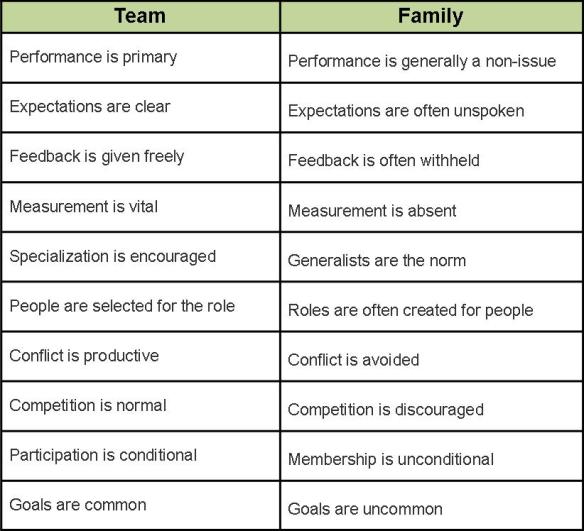
Today I read a blog post by Mark Miller that clarified this exact issue for me. His post helped me to understand that when we view our team through a family perspective, we often allow performance to suffer. This is a common problem for non-profits and religious organizations. I remember many times when we erroneously did not confront poor behavior, implement consequences, or even ask someone to leave the organization… because we did not want to lose a “family” member. This distorted perspective means that we postpone and avoid crucial decisions that often cause great harm to the individual and to the organization. 

This wise comparison comes directly from Mark Miller’s post:

team or family

Mark clarifies that many of the “family” characteristics are great additions to a healthy and fruitful team environment. Applied correctly, these elements create community, which leads to greater trust, shared responsibility, and performance. A sense of community on a team is beneficial, but as Mark says, “However, unlike in a family, to be a member of the community is conditional.”

Does your team work like a team or a like a family?

*** For excellent content on leadership, follow Mark Miller’s blog, Great Leaders Serve, at: http://greatleadersserve.org/

chocolate, character and community

I love chocolate. Chocolate cake, chocolate cookies, chocolate pie, chocolate brownies, chocolate candy (especially with nuts). I can easily pass on most sweets… but not chocolate. Over the years, my tastes have drawn me to dark chocolate. That is now my unquestionable favorite.

yum webWhen I was recently in Birmingham in the UK, we had the opportunity to tour the Cadbury factory. What a treat! I have always enjoyed learning about how things are made, but chocolate… the best of all worlds! It was a chilly day for walking around… but so worth it! Our first stop included a sample of warm, melted chocolate over our choice of toppings. It was amazingly delicious – as you can tell!

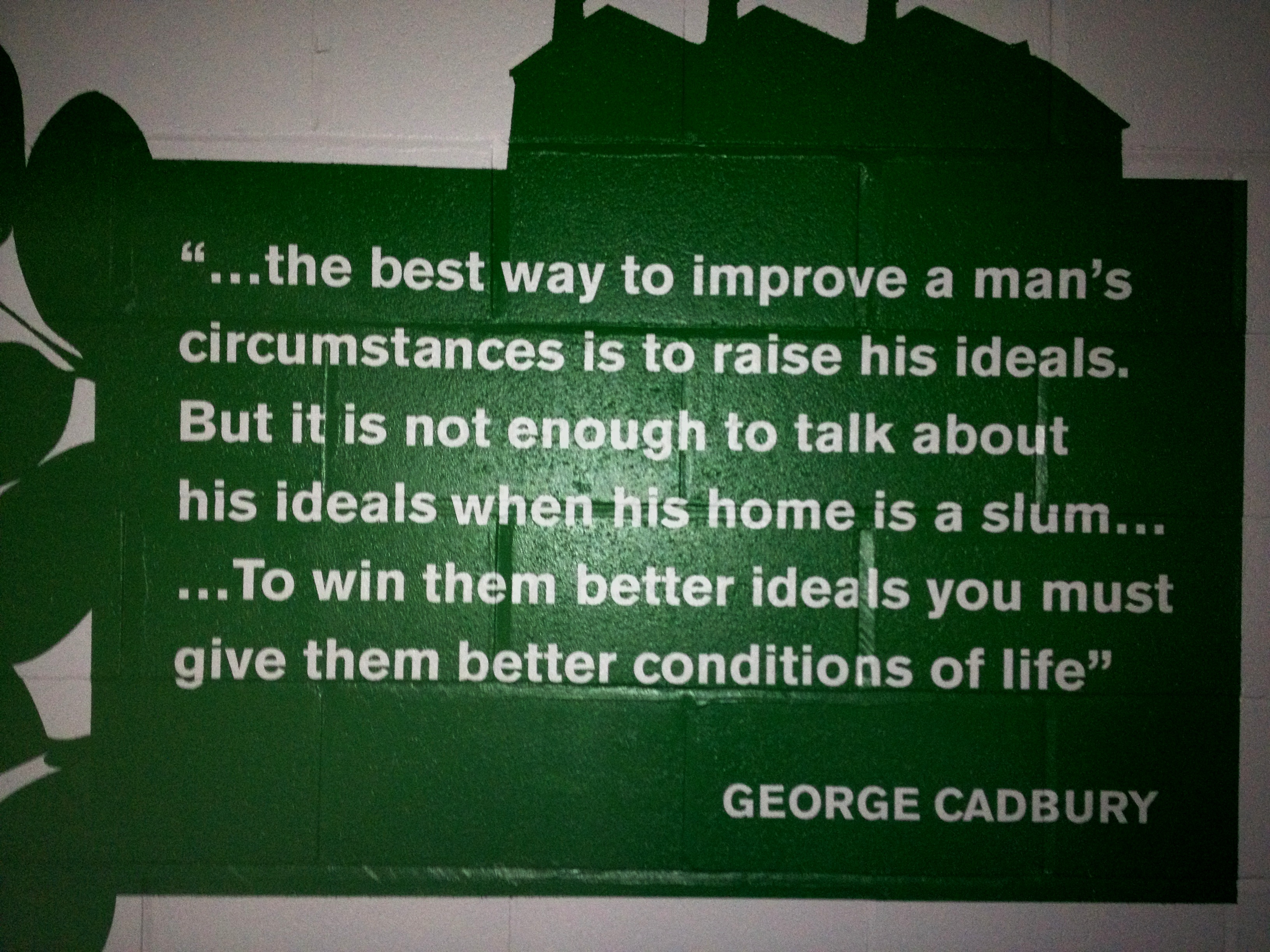
better conditions webWe then moved on to displays that demonstrated a bit of the history and processes. A friend had encouraged us to look for the Human Resource connections in the company foundations, and we were not disappointed. George and Richard Cadbury were men of great character. They obviously cared for people as well as profit… and did not sacrifice quality or integrity to accomplish both goals. There were numerous testimonies and historical evidences of the Cadbury’s commitment to their employees and their families. The Cadbury brothers provided out-of-the-norm housing and education opportunities, dental and medical care, recreation and vacation possibilities for their workers. I have often sensed the tension between people and production, but these men have proven that both can flourish together.

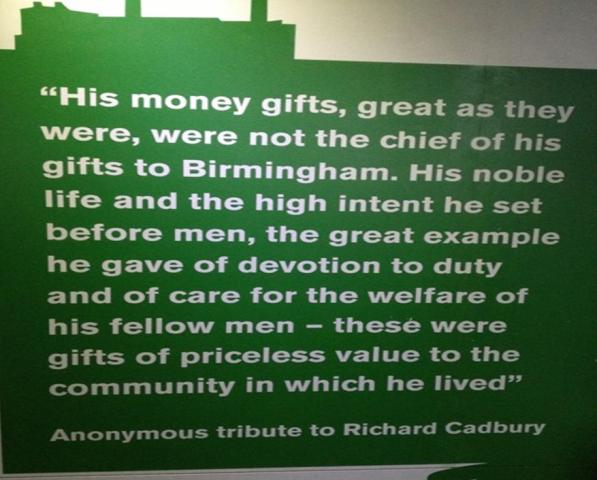
greatest gift horizontal webGeorge and Richard took care of their people by providing community. In 1879, the Cadburys expanded their facilities… and their contributions to Birmingham. The factory, called Bournville, was known as a “factory in a garden” because of the stream, green areas, and gardens all throughout. It is still a very attractive place today. The brothers built homes, schools, hospitals, reading rooms, and gardens for what became known as Bournville village. George and Richard understood that as they invested in individuals, they ensured a society change ROI also. Their example was inspiring to me as I dream about the positive impact that my actions can have in a scope much larger than my own life.

I’ve included a few references below if you’d like to read more about the Cadbury legacy. I suggest that you accompany your study with a Cadbury Milk bar or a Cadbury Egg – for maximum educational benefit!

IMGP0120

Have you experienced leaders who are able to combine care for their people and profit/success?

__________

http://www.spartacus.schoolnet.co.uk/REcadbury.htm
http://www.cadbury.com.au/about-cadbury/the-story-of-cadbury.aspx
http://candyhalloffame.org/CHoF/inductees/2005/richard-george-cadbury.shtml