seeing myself as a system

cables clint-adair-BW0vK-FA3eg-unsplash

I’m reading a book these days about leading change. My hope is that the book will help me and my team learn how to help others flourish – even through changes in our fast-paced, uncertain, complex world. I am learning a lot that will apply to the organization, but this morning I read something that applies personally to me.

I’ve struggled for a while with my inability to name my own desires and preferences with confidence. I hear others say without hesitancy, “This is what I like” or “This is who I am”, but I can’t seem to do that. I’ve wondered why. I’ve wondered if something was wrong with me.

The chapter titled, “See Yourself as a System”, gave me a fresh way to look at this.

The chapter starts out with the story of an Army officer who does not agree with some of the self-protective but unstrategic behaviors of the men he is commanding, but who does not stand up to them because he wants solidarity with the unit. The officer’s tension is an illustration of the complexity of our human system, with its “competing values and interests, preferences and tendencies, aspirations and fears¹”, many of which he linked back to needs he had developed during his upbringing.

The authors explain that our personal system is an inter-tangled network of our personality, life story, intellect, skills, and emotional intelligence. Our behaviors and decisions are affected by all of that and the situations, conditions, loyalties, experiences, and bandwidth that we have at any given time.

The chapter suggests that we cannot effectively lead change if we do not understand our system and our “multiple identities” that are a result of that reality. Not multiple identities in a psychotic or lack of integrity kind of way, but the fact that we do – in a healthy, authentic way – show up differently depending on the role we play, the need of the times, and the new growth we can bring to a situation now.

Personally, I felt a sense of relief when I read this. I was encouraged to hear that my perceived struggle with a set identity definition could actually be a benefit to a changing organization when I view myself as a complex system – less easy to describe, growing, updating, and changing over-time, rather than static, fixed, defined, and fully-formed. It’s given me a hopeful lens to consider some of my tensions. I’m looking forward to reading more about loyalties, influence factors, and roles in the next chapters.

What do you think? What is your perspective on being a “system”? 


¹ R. Heifetz, A. Grashow & M. Linsly. 2009. The Practice of Adaptive Leadership – The Tools and Tactics for Changing your Organization and the World, Harvard Business Press, p 178.

Photo credit: Clint Adair on Unsplash


One Word 2020 – LOVE

Photo credit: alex-block-ar9-UYZZmqs-unsplash

I’m very late to the party this year. So many things have been going on in my life – there was no longer time or energy for writing. However, I attended a wonderful writer’s conference in January led by Leslie Leyland Fields, and she has motivated me to look for time to write again. I cannot guarantee that the motivation will result in action, but I am going to see where it takes me.

Today I simply want to record my word for 2020. For quite a while now, I’ve been choosing a word to represent a focus or area of growth for each year, and this year my word is LOVE.  

I was drawn to this word for two reasons. First, I have felt so burdened, saddened and heartbroken by the divisions, taking-sides, lack of conversations, and meanness that I’ve been experiencing in our world recently. I certainly see it in social media and in the news, but I also have felt it too often at work and in relationships close to me. I’m not certain how my word will transfer into action, but I want to be open to whatever God shows me in this next year and beyond.

My second reason has to do with my struggle to love myself. I have an on-going critical voice in my head that constantly points out my imperfections, my less than ideal performances, my self-doubts, and my supposed imposter status. Despite some growth in this area over the years, I still have a long way to go.

Since I am convinced that doing better at loving myself is closely integrated with loving others well, I’ve given myself a two-for-one focus this year.

If I actually get around to writing more this year, you will see the word LOVE show up again and again. Even if I don’t write again, this post will have been worth it if you take a moment and pray for me to listen intently to God’s direction for how to practice the word LOVE each day. I would appreciate that a lot.

What is your word for 2020? How are you doing with that focus now that we are two months into the year?

What suggestions do you have for how I can learn more about LOVE this year?


Love never gives up.
Love cares more for others than for self.
Love doesn’t want what it doesn’t have.
Love doesn’t strut,
Doesn’t have a swelled head,
Doesn’t force itself on others,
Isn’t always “me first,”
Doesn’t fly off the handle,
Doesn’t keep score of the sins of others,
Doesn’t revel when others grovel,
Takes pleasure in the flowering of truth,
Puts up with anything,
Trusts God always,
Always looks for the best,
Never looks back,
But keeps going to the end.

1 Cor 13: 4-7 (The Message)

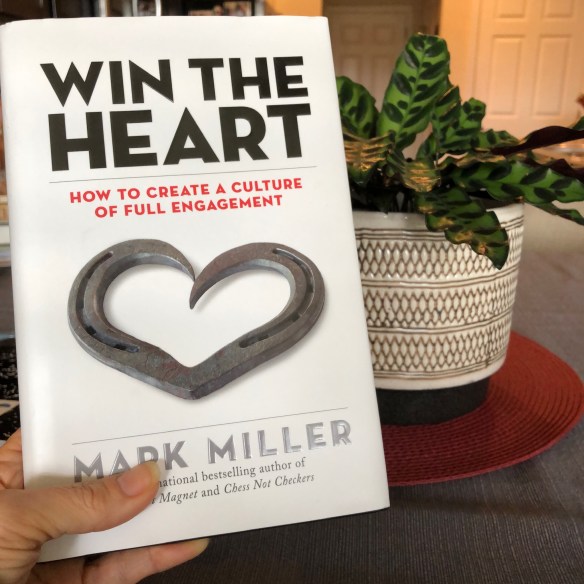
Win the Heart

Do you love your job? Are you excited about the work you get to do?

In my work, we talk a lot about engagement, not the pre-marriage kind of engagement, but rather the whole-hearted, full-energy, dedicated-to-our-work kind of engagement. We offer personal and professional assessments to individuals and development training to our team leaders in the hope that we can help build that type of commitment for the work we do. I’ve just read a new book that is a great resource for those of us who desire to see full-out engagement in our co-workers and wanted to share it with you.

We CARE about our people,
and we want our people to CARE about their work.

Mark Miller, author of the new book, “Win the Heart“, understands true engagement is a matter of the heart. He explains that engagement matters because people matter. He believes, “We can create a place where [people} can bring their best selves to work every day”, where people find meaning and purpose, and where they gain energy as they work.

Engagement is also an important element of organizational culture. It unlocks the potential in people and increases productivity for our mission and goals. Engagement helps to create a high-performance organization that recruits top talent, develops quality leaders, and excels in all we do.

Mark writes in a simple yet powerful way through the medium of story. The main character in the story, Blake, takes personal responsibility, as the team leader, for the sluggish indifference of his team members. Blake goes on a journey – through history and around the world – to discover the secrets that will equip him to help his team engage fully with their work.

Blake’s journey leads him to discover four cornerstones of CARE:

  • CONNECTION – conversations with clients and each other
  • AFFIRMATION – saying “thank you” and other forms of appreciation
  • RESPONSIBILITY – empowering versus micromanaging team members
  • ENVIRONMENT – a combination of mindset, belief, and resources

Through the story, Blake finds both historical examples and practical tips for how to build these cornerstone elements into team relationships. I think story is a great way to learn new concepts, and I highly recommend Mark’s book for any team leader who cares about their team and wants to ensure that the team members feel encouraged and empowered to do their best work. The examples and tips are helpful and easy to remember (maybe a bit more challenging to apply!).

Team members will also enjoy this engaging story and learn a vocabulary that can assist in conversations that will help build the optimal work experience that produces top results.

Mark’s book is a quick read, but applying the concepts of CARE will have a long-lasting positive impact on your team’s engagement. You can also visit Mark’s new website or read some of his other great books: The Heart of Leadership, The Secret, Chess not Checkers, Leaders Made Here.

I’d love to learn from you…

What motivates you to care about your work?

How have your built engagement on your teams?

coming together

I carry a heavy burden on my heart for the way our world is so fractured and divided these days. I have lived a lot of years, and I do not remember it being like this before – a very clear and determined “us versus them” – with anger, hatred, meanness, and unwillingness to listen to each other prevalent in every sector of our society.

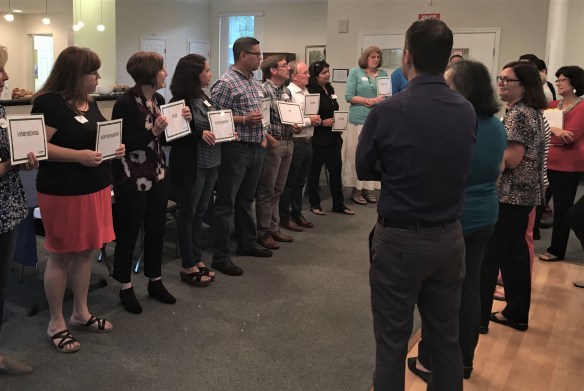
While some segments of our population struggle for equity or validation, others defend their positions or past privilege without any heart willingness to consider a contrasting point of view with an open mind or compassion. We take sides, brother against brother, and spew ugly contempt on anyone who presents a differing story or opinion. 

Every work style preference or personality assessment I’ve ever taken – and I’ve taken a lot – has shown me the obvious truth everyone else is not the same as me. Even the most simplistic assessments usually categorize people into at least four different types.  This tells me that at least 75% of the world may experience any number of life issues from a perspective or preference that greatly differs from mine. Those assessments also tell me that it is important to know myself AND respect others. They remind me that I desperately need other people – who are not like me – to fill my gaps.

What has happened to our respect for others?

What has happened to appreciating differences?

What has happened to human kindness?

Brené Brown addresses the “sorting” that we often do and experience today in her excellent book, “Braving the Wilderness“. She claims that although we desperately desire belonging, we will not find it by picking sides and lobbing grenades of division and defensiveness at each other. As a social work PhD, she is greatly concerned, as I am, by the current status of our world. Thankfully, she does not dwell only in the negative reality, but she also offers some positive alternatives:

“People are hard to hate close up. Lean in.”

Brené explains that as a social species, our greatest strength is not found in “rugged individualism” but rather in our ability to communicate, care, and work together. Connection matters – and it is in getting to know people up close that dispels the generalizations, false stereotypes, suspicions, and fears that drive us apart.

Getting to know each other up close requires honest curiosity about people who are different from me, the courage to step out of my comfort zone, and a willingness to enter into tough conversations. Not always easy to do, but the benefits gained from collective social connections make it worth the effort.

This post only scratches the surface of this topic – Brené presents a deeper perspective in her book. I highly recommend it.

For now, I chose a few action points:

  • Admit when I am no expert on a topic and ask good questions to learn more
  • Intentionally initiate to get to know people who are different from me
  • Actively listen to understand – especially deeper heart issues
  • Speak up about those beliefs I hold strongly
  • Invite others to tell me if they experience me “sorting” people

How have you experienced “sorting” or the “us versus them” mentality? 

How have you attempted to come together with others – especially those who are different from you?

_____________________________

**You might also enjoy this post, “standing alone” or check out Brené’s website (she offers free reading guides for her books).

standing alone

alone beata-ratuszniak-5430-unsplash

I do not believe in preaching something to others
while not doing that same thing myself.

I’ve written and spoken on “unhurried living”, so I’ve also attempted to live out those truths in my life this year. One way I have done this is to guard a number of reading, reflecting, and/or writing hours each week. This has not been easy for me, but it has been so very worth it, whenever I’ve followed through on this plan.

So far, one of my favorite books to read was Brené Brown’s “Braving the Wilderness”. Brené writes about a couple of topics in this book – all were very challenging and helpful for me.

Brené’s main topic, and the subtitle of the book, is “the quest for true belonging and the courage to stand alone”. She launches the challenge with a quote by Dr. Maya Angelou…

You are only free when you belong no place —
you belong every place–no place at all.
The price is high. The reward is great.

Although this sounds like a paradox, there is deep truth in these words. Brené claims that we can never feel like we fully belong with others until we are willing to stand completely alone (“in the wilderness”). We must learn to individually accept our authentic, vulnerable, and imperfect self so that we do not give in to the pressure to change or hide our true self so others will accept us.

Before we will ever be comfortable with others, we must believe in ourself.

Brené also claims that we connect better with others when we are more courageous with our real self – not going along with gossip, group think, or people pleasing – but risking even loneliness to speak truth and defend what we value most.

If we betray our deepest foundational beliefs to “fit in”, we will always live in fear of being “found out” as an imposter – and rightly so.

We will never experience true belonging when we live as a fake.

Belonging requires bravery and trust that the ONE who made us knew what He was doing – He did not make a mistake – and our ultimate belonging comes from Him.

Brené shares other great messages in her book, and I will write more next week. This week I want to practice true belonging. I am going to do my best to:

  • Give myself grace when I become aware of my weakness, imperfection (my 2018 theme is “embrace imperfection“) or failure
  • Lean in and bravely speak truth instead of going along with others, if I disagree
  • Offer a safe, non-judgmental response to others who offer a differing opinion – hopefully encouraging them to brave the wilderness also

I’d love to hear from you… When do you struggle to accept yourself? How have you learned to “brave the wilderness”? 

learning by doing

Our Keith Webb workshop was so good! I am very grateful for my teammates who facilitated our training with excellence. I want to share two of my highlights with you.
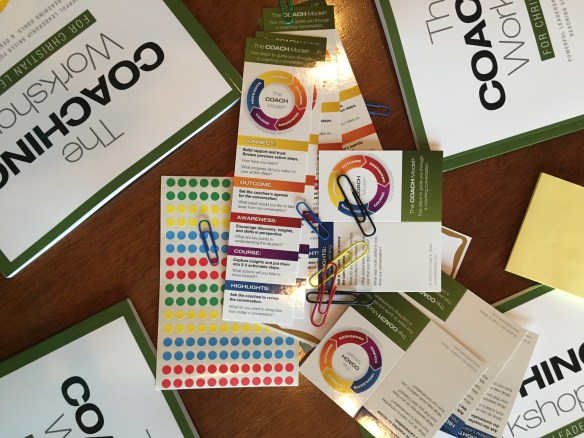

1 – First, the workshop used adult-learning (andragogy) many times everyday. 

I enjoy attending trainings when the facilitator uses adult-learning principles. I also appreciate the opportunity to add some new creative ideas to my toolbox.

Some key adult-learning principles:

  • Honor the knowledge and experience of the audience
  • Allow the adult learners to self-direct their learning by planning – as much as possible – what content to cover
  • Make the workshop task or problem-oriented using realistic and relevant situations rather than content-oriented.
  • Use varied activities for multiple learning styles and information retention.

These are some of the creative adult-learning activities we experienced during the workshop:

  • Personal reflection time to record what we hoped to learn as well as our desired coaching topics before beginning the workshop
  • Practiced coaching in pairs, triads, and speed-rotating around the table
  • Coached on real life issues
  • Reviewed material by teaching it back to our peers
  • Acted out concepts, watched videos, worked in small groups, created metaphors, and asked for feedback to better learn the concepts
  • Summarized the highlights and action steps at the end of each day

2 – Second, the workshop demonstrated that even while stumbling through a new method and making many mistakes, people discovered break-through ideas that were encouraging and hope-filled.

Personally, I considered some of the deeper heart issues behind one of my struggles, cried, laughed, and left the workshop with practical and do-able action steps.

This is the power of coaching. When a coach asks powerful questions, listens with full engagement, helps move the coachee toward action, and trusts God to do the transformational work… great things happen!

How can you integrate some of these adult-learning ideas in your next training / teaching / workshop opportunity?


Again, to learn more about Keith Webb’s coaching model, you can buy the book HERE, read Keith’s blog, or look up one of his workshops via his website HERE. Highly recommended. 🙂

Other posts about Keith Webb’s coaching model: how’s that working for you? and want to be a good coach?


want to be a good coach?

Keith Webb's "The Coach Model"

Coaching values the coachee’s past experience, honoring his/her knowledge and
decision-making skills, and fostering ownership of chosen action steps. 

Keith Webb’s, The Coach Model, offers an excellent process that helps me to focus on coaching rather than talking, and enables me to help the persons I’m coaching discover solutions for themselves. You’ll notice that Webb’s five process steps spell COACH so that it easy for to remember. Here is a quick summary of how it works:

CONNECT — How are you?

A good coach begins the conversation catching up on anything that has been going on since the last time together. This “small talk” helps to build relationship trust and ensures there is no major distraction going on that might sabotage the discussion that day. An especially difficult situation may require rescheduling the appointment or simply acknowledging the trial may lessen the pressure enough to continue with the conversation.

During the Connect time, a good coach will also ask about previous action steps. The question, “What progress did you make on your action steps?” positively assumes progress, validates partial completion, and focuses on what worked well. This is also a great time to address any struggle or failure and help the coachee adjust the action steps if necessary.

OUTCOMES — What would you like to work on today?

Once the past action steps have been reviewed, it is time to for the coachee to state his/her desired outcomes for the meeting. A good coach helps the coachee by asking questions that narrow the topic enough to make progress in the time allotted. Some questions that help:

  • Explore: What might be the deeper issues? What do you want to achieve?
  • Clarify: What do you mean by…? Could you give me an example of…?
  • Focus: Which part of the problem would you like to work on today?

AWARENESS — What can you discover about this issue?

Once the coachee settles on a topic, a good coach asks lots of powerful, open-ended, questions to help the coachee reflect, increase perspective, and consider different angles that might be helpful.

A good coach will be careful to ask questions that benefit the coachee. For example, a coach doesn’t need to know all the details of past situations, so better questions focus on what the coachee wants to see in the future.

Tell me about the conflict.
vs
What would excellent resolution of the conflict look like?

COURSE — What will you do this week to move forward?

Now it’s time for action! Once again good questions help the coachee generate a variety of possible action steps, evaluate the options, and then choose the best one(s). Using SMART (Specific, Measurable, Actionable, Realistic, Timely) goals ensures the coachee confirms the what, how, by when, and with-what-help details of the actions, increasing the follow-through.

HIGHLIGHTS —  What are your “take-aways” from our conversation?

“We build our brains by repeating things.” ~ Keith Webb

A good coach closes the conversation by asking summary questions for the coachee to review and repeat newly gained awareness or knowledge and useful or meaningful aspects from the appointment. This helps to embed the learning and give some feedback to the coach also.

If you want to learn more about this process and increase your coaching skills, I highly recommend Keith Webb’s book, The Coach Model. You can also follow his BLOG or attend one of his workshops.

I’d love to hear from you… What are your best tips for coaching well?  What process do you use for coaching? 

_________________________

You might also like: how’s that working for you?a coaching process you can use, asking powerful questions,  or questions for a destination

how’s that working for you?

Photo by CloudVisual on Unsplash

Some of my worst experiences with people
had to do with me trying to convince someone else of my “great” idea.

In one way or another, I was displaying what Keith Webb calls my “know-it-all-ism”. It was not pretty, and it did not work nearly as well as I hoped it would. It often resulted in high resistance, defensiveness, or hurt feelings – none of which I intended, but I definitely caused that impact. Turns out, telling people what I think they should do doesn’t work very well for me at all.

I am reading Keith Webb’s book, The Coach Model, in preparation for a coaching training I get to attend soon. So far, the basic concepts are not brand new, but they are excellent reminders of key principles and practical helps. They have convicted me in many places and encouraged me in others. Rather than experience this range of emotions alone, I thought I’d share some of them with you!

First, a summary of the symptoms of “know-it-all-ism” – just in case you want to join me in the painful self-awareness process…

Keith explains that there are two types of “know-it-alls” – aggressive and passive:

aggressive know-it-alls:

  • are quick to speak
  • listen – until the other person takes a breath
  • have an answer for everything
  • win arguments, but lose respect

passive know-it-alls:

  • pretend to listen
  • maintain a smug facial expression
  • ask questions that subtly point out why the speaker is wrong
  • internally mock or criticize the speaker

Ouch. I am guilty of both of these.

How about you? Ever act like a know-it-all?

Thankfully, the book offers a better way. Keith Webb defines coaching as:

An ongoing intentional conversation that
empowers a person or group to fully live out God’s calling.

This kind of conversation eliminates the need for me to know it all. It also releases me from the self-imposed responsibility of changing the other person or correcting whatever I feel that person is not handling correctly (yet).

A coaching conversation of this type puts the attention on what God has in mind for the person and allows it to happen in His timing – not mine. There is incredible freedom in this coaching. Keith writes that freedom often feels risky – like accompanying the person on an unknown journey – but at least it will be their journey, rather than mine. I’ll have less control, but I have a feeling that will work out better for both of us.

I’m looking forward to learning more from this book and from the training. I’ll share more in a next post – stay tuned!

what makes you happy?

Photo by Zachary Nelson on Unsplash

I find joy most days and in most situations. I am generally optimistic and look for the best in people. My faith tells me God is good and so are His plans. Even so, sometimes sadness or stress lands heavy on my shoulders.

The other day an article captured my attention. It offered four practical activities, supported by neurology, that will help make us happy. The four actions are not difficult to apply, even if we are not brain researchers, and they are simple yet powerful. I want to share them with you:

1. Ask, “What am I grateful for?

“Gratitude makes us feel better” + “A grateful attitude improves our mood and increases our energy” = TRUTH. Gratitude activates our brain to produce dopamine and serotonin – chemicals that enable us to see rewards and take action to move toward them. As an additional benefit, when we are grateful for something or someone, those chemicals give us a natural “high” which motivates us to feel it again and so repeat the process.

The article also taught me something new:

Even when life is hard and we can’t find anything for our gratitude list…
it doesn’t matter! The simple act of searching has the same effect!

2. Name your negative feelings.

Pretending not to feel bad or suppressing negative emotions does not work to make us feel better, and sometimes has the opposite effect. Even if we can fake it on the outside, our internal limbic system is reacting.

On the other hand, if we voice our feelings, it reduces the amygdala reaction in our brain. Describing our emotions with a word or two helps diffuse the intensity.

We will increase our happiness
when we state how we feel when we are not happy.

**An interesting side note: Labeling is a primary tool used in hostage situations to diffuse negative emotions.

3. Make a decision.

Making decisions also calms the limbic system, reducing stress and worry. We do not have to make a perfect decision – a good enough decision will help. Deciding gives us a sense of control, and feeling in control reduces the stress hormone cortisol… and increases dopamine activity. In addition, if we do something because we “should” or because we “have to”, we do not get the same benefit.

We feel better when we choose to do something that produces a good result
than when something good happens by chance.

4. Touch people.

When we feel rejection in relationships, our brain circuitry reacts the same way it does for physical pain (activating the anterior cingulate and insula). We all need to feel love and acceptance.

Small touches like handshakes and pats on the back release oxytocin which activates pain-killing endorphins. Holding someone’s hand during a medical procedure lowers the discomfort level. Massage also increases dopamine and serotonin activtity. And the more we care for the person, the more their touch helps.

Hugs are powerful.

So there you have it. Four “easy” activities that can make you more happy. 🙂

Which of these activities can you practice today? What else makes you happy?


You might also want to read: got the gratitude attitude? or learning to be thankful

(embrace) imperfection: my word for 2018

dented car adam-griffith-252508

Photo by Adam Griffith on Unsplash

I chose a word last year, but wasn’t writing faithfully, so never put it out there for others to know. That’s not important since a word for the year isn’t chosen to flaunt or compare with others, but rather to help focus attention, effort, and growth for the individual who choses the word.

This year I am back at it. I am sharing my word with you, not to say you should pick a word yourself or to show off mine, but rather because somehow putting it into print gives it a kind of “officialness” – a concreteness for me – maybe even a bit of accountability from the few who read this and know me well enough to ask me about my word during this next year. 🙂

2018: embrace imperfection

Ok, it’s sort of two words, but again, that’s not important. What matters is that I have struggled with perfectionism most of my life. It has caused me to be very critical of myself and others. It causes me to be continually discontent: nothing is ever completely finished, good enough, or all that I would like it to be. It drives me to want more, to do more, to be more. All. The. Time.

im • per • fect: (n.) someone or something characterized by faults or weaknesses that do not necessarily impair its use; not fully formed or complete; still in process

As I have grown, I have learned to temper my perfectionism. With four children, it didn’t take me long to realize a perfect home would never be a reality. My love for them made it not too difficult to value hospitality, community, and other’s learning over picture-perfect decoration and neatness.

At work, valuing teamwork, shared leadership, and coaching new leaders fairly easily took priority over my personal perfectionist tendencies. I care more about encouraging and empowering others than I do about imposing an unrealistic perfection standard.

I know I don’t practice this perfectly (duh!), and I know others don’t always experience the grace I would like them to get from me, so this year I want to focus on embracing my imperfection.

I am convinced that other’s won’t feel that imperfection is OK in them
if I don’t feel that imperfection is OK in me.

I recognize that when I play my tape forward, my internal unrelenting desire for perfection reflects the ridiculous delusion that if I just worked at it hard enough, I could actually get to the place where I never need grace myself. I would never make mistakes. I would never need forgiveness. I would never need help. I wouldn’t need a Savior.

That’s crazy. Perfection will never be my reality. It is not possible. It isn’t even desirable in my heart. I long for community and I long for connection with God and others.

Imperfection enables closeness.

Imperfection does not have to prevent closeness as I often erroneously think it does. Rather than withdrawn from people because I am not handling my thoughts, words, or actions perfectly, I can lean in closer to others and experience their grace and support that encourage my heart and help me grow. Truth is, imperfection makes me more accessible and people have continuously surprised me with their judgment-free acceptance of my imperfection.

This year I want to get better at embracing my imperfections rather than running from them or attempting to hide them. This may be one of the most challenging words I’ve ever chosen. Maybe I will be brave enough to let you know how it’s going as the year goes on.

What are some of those “crazy-makers” that you battle in your heart? 

If you have one, what is your word for 2018?